No products in the basket.
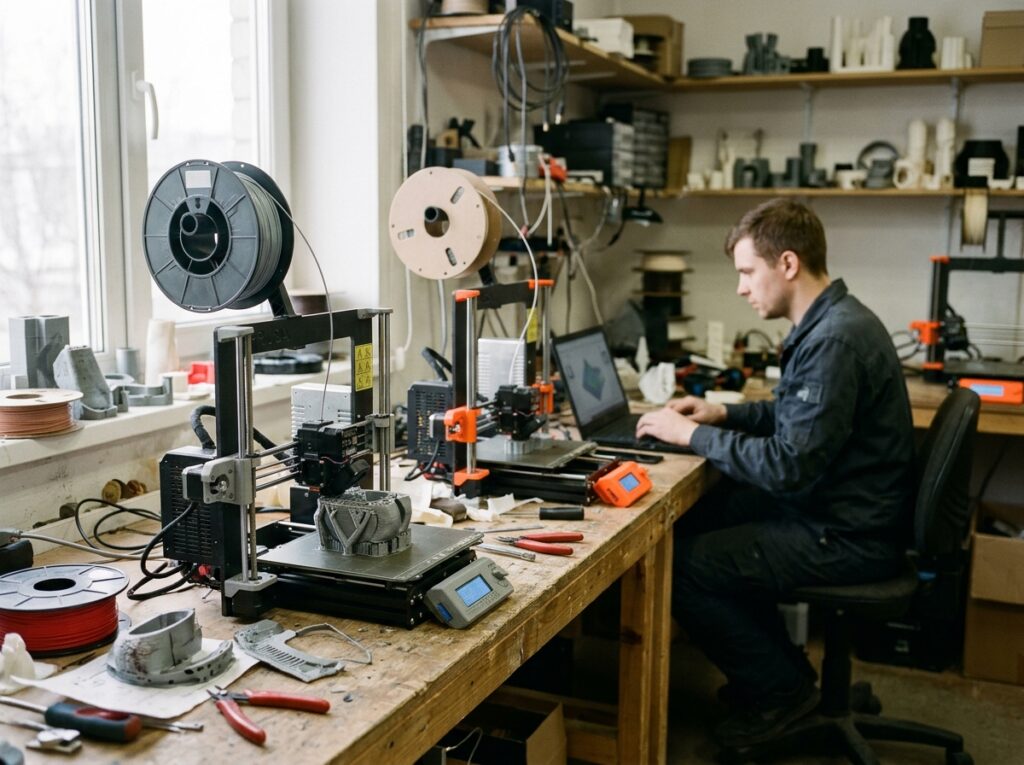
Ordering 3D printing online works like this: you upload your file (STL, 3MF or STEP), choose a technology and material, see the price and lead time on screen, and pay. No printer to buy, no minimum order quantity, and standard orders leave our workshop within 24–72 hours of confirmation.
- Price: parts start at €2.24 each in PLA, PETG, ABS or ASA, €4.12 in standard SLA resin and €4.50 in PA12 nylon (SLS). A single unit of a model starts at €4.50, VAT included.
- Lead time: FDM and SLA orders take 3 working days on average, SLS around 5. Delivery to Germany or France takes 2–3 days.
- Files: STL, 3MF and STEP (OBJ too), up to 200 MB per file, one body per file, units in millimetres.
- Quantity: from a single part up to runs of 5,000, with volume discounts from 5 units.
- No customs: we manufacture in Spain, inside the EU, so there is no import VAT or customs clearance to pay on delivery.
- What the instant quote can’t guess: layer orientation, which face is cosmetic and which dimension is critical. Tell us in the order notes.
How does ordering 3D printing online work, step by step?
There are five steps, and only the first one needs any preparation on your side. The calculator analyses your part and gives you a firm price and lead time before anyone touches the file.
- Upload your file to our online 3D printing calculator with instant pricing: STL, 3MF or STEP. We print it ourselves, in our own workshop in Valencia. We are not a broker passing your job on to someone else.
- Choose the technology and material. This is where most of the price difference between two quotes comes from, so compare options before you decide.
- Set the quantity. From 5 units of the same model, volume discounts bring the price per part down.
- Pay, and the order goes straight into the production queue, with no sales rep in between.
- Receive your parts: standard orders ship within 24–72 hours of confirmation, and delivery to Germany or France takes 2–3 days.
The difference between a platform that farms out jobs and a workshop with its own machines shows when something needs a second look. Every part we make goes through a visual inspection and a tolerance check before it ships, and if anything isn’t right, you talk to the people who actually printed it.
Which file should I upload: STL, 3MF or STEP?
All three are quoted just as quickly. STL is the standard, 3MF stores units and avoids the classic scaling error, and STEP keeps the exact CAD geometry, so holes and curves don’t arrive faceted.
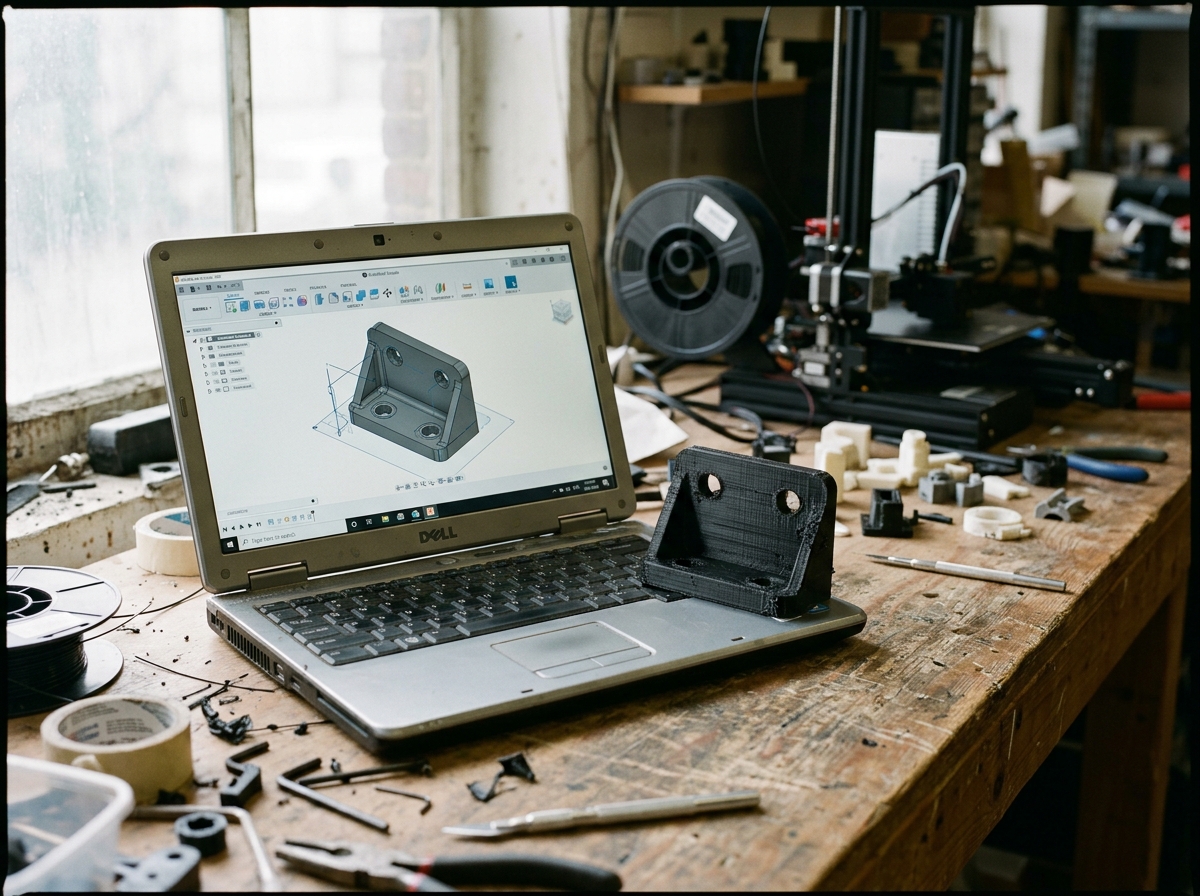
If you design in SolidWorks, Fusion or Onshape, export STEP and you can skip mesh repairs altogether.
How much does it cost to 3D print a part online?
Less than most people expect. The minimum price per part is €2.24 in PLA, PETG, ABS or ASA, and a one-off unit of a model starts at €4.50, VAT included. What moves the figure is mainly the volume of the part, followed by the material and the technology. These are real examples from our price list (price per part, VAT included):
| Part volume | PLA (FDM) | PETG (FDM) | Standard resin (SLA) | PA12 nylon (SLS) |
|---|---|---|---|---|
| ~5 cm³ | €2.24 | €2.24 | €4.12 | €4.50 |
| ~25 cm³ | €3.72 | €4.75 | €12.05 | ≈€12 |
| ~100 cm³ | €14.87 | €19.00 | €48.20 | ≈€47 |
Other starting prices: PETG ESD from €2.21, wood-fill PLA from €3.24 and flexible TPU from €4.50. One setting people often overpay for is infill: printing at 100% infill instead of the standard 20% makes a part roughly 35% more expensive, and for most prototypes it adds nothing useful.
Ordering several units of the same model brings the price per part down:
| Quantity | FDM | Resin (SLA) | SLS |
|---|---|---|---|
| 5 units | −15% | −10% | −2% |
| 10 units | −20% | −15% | −3% |
| 25 units | −25% | −20% | −5% |
| 50 units | −30% | −25% | −7% |
| 100 units | −35% | −30% | −10% |
| 250 units | −45% | −35% | −10% |
| 500 units | −50% | −50% | −12% |
Our practical advice: for a functional prototype that will be bolted to a machine, FDM 3D printing in PETG or ASA gives the best value for money. Keep SLA resin printing for parts that need fine detail or have to look good, and SLS in PA12 nylon for parts that flex, clip together or have complex geometry. The full breakdown is on our 3D printing prices page. And if you are weighing up buying your own printer instead, Prusa’s guide to calculating printing costs is a good place to start.
Why can a cheap quote from outside the EU end up costing more?
Because the price of the part is not the cost of the order. Since 1 July 2021, the VAT exemption for consignments worth €22 or less no longer exists: anything shipped into the EU pays import VAT at the buyer’s national rate (19% in Germany or 20% in France, for example), and the carrier adds its own customs handling fee on top.
| What you pay for | Manufacturer inside the EU (Imprimakers) | Platform shipping from outside the EU |
|---|---|---|
| VAT | Included in the price you see | Import VAT at your country’s rate, charged on arrival |
| Customs clearance | None | Carrier’s customs handling fee |
| Lead time | Ships within 24–72 h; 2–3 days to Germany or France | International transit plus customs clearance |
| Who makes the part | Our own workshop in Valencia | Often a partner you never get to choose |
| If a part arrives with a manufacturing defect | Write to us and we’ll sort it out | Another international shipment and another wait |
The official rules are set out on the European Commission’s Taxation and Customs Union website. For low-value parts, the apparent saving of ordering from outside the EU usually disappears once VAT and handling fees are added, and that’s before counting the extra days in transit.
How long does an online 3D printing order really take?
Always separate production from transport. Standard orders leave our workshop within 24–72 hours of confirmation. On average, FDM and SLA take 3 working days and SLS around 5 working days, because every SLS build has to be preheated, printed, cooled down and cleaned.
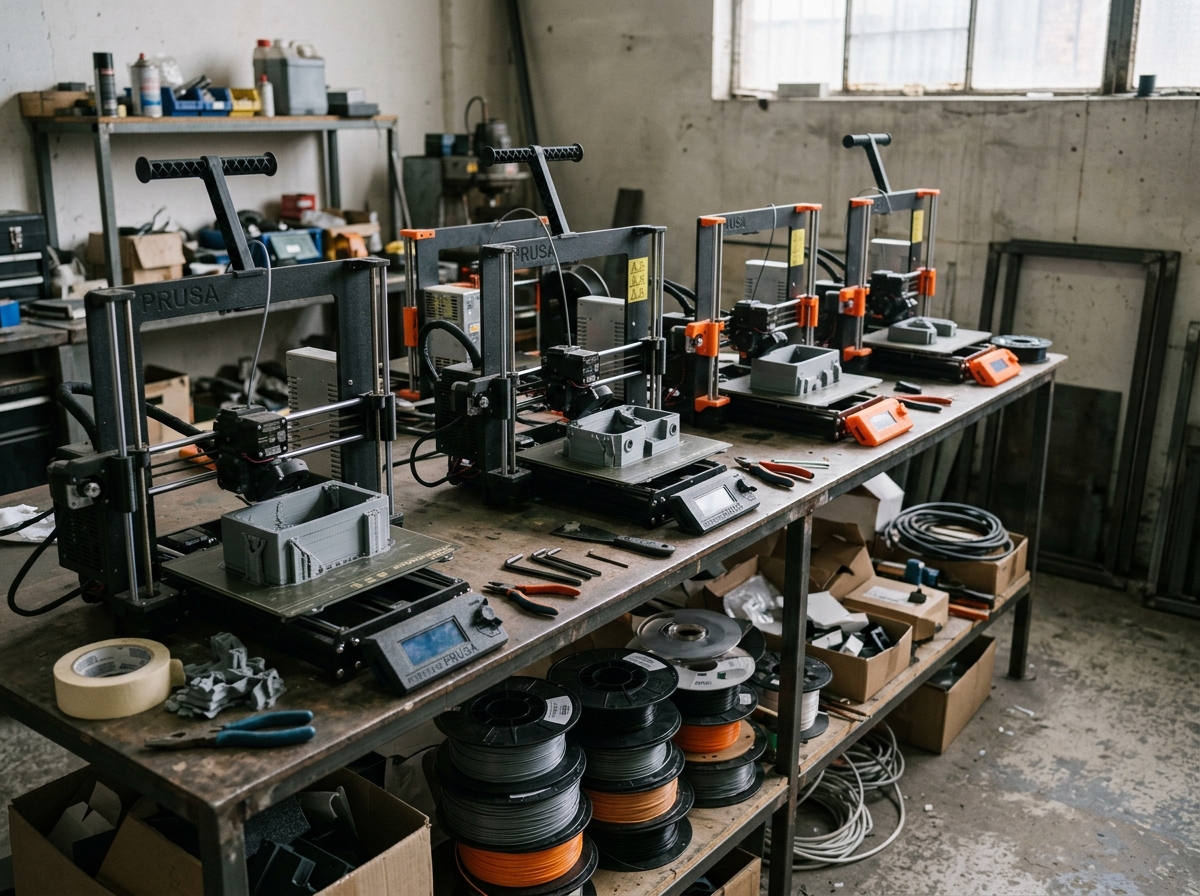
Delivery to Germany and France takes 2–3 days, and we also ship to Spain, Portugal and the rest of the EU. With more than 40 printers in our own workshop, the work is spread across many machines instead of queuing for a single large one, which keeps standard lead times predictable.
If you have a hard deadline, such as a production line waiting for a replacement part or a trade fair on Monday, contact us before ordering and we’ll tell you honestly what’s achievable. For jigs, fixtures and spare parts for production, have a look at our 3D printed industrial parts service.
Can I order just one part?
Yes. There is no minimum quantity: we make anything from a single part to runs of 5,000. A one-off unit of a model starts at €4.50, and ordering one part works exactly the same way as ordering a batch of hundreds.
We have produced more than 100,000 parts, and single prototypes and production batches go through the same queue and the same quality checks.
What accuracy, tolerances and wall thickness can I expect?
3D printing is not machining. Plan for ±0.3 mm or ±0.3% in FDM, ±0.1 mm or ±0.2% in SLA and ±0.3 mm per 100 mm in SLS, and design fits with clearance instead of expecting a perfect press fit first time.
| Technology | Typical tolerance | Minimum wall thickness | Minimum detail | Maximum size in one piece |
|---|---|---|---|---|
| FDM | ±0.3 mm or ±0.3% | 0.8 mm | 0.4 mm | 500 × 500 × 500 mm |
| SLA (resin) | ±0.1 mm or ±0.2% | 0.4 mm supported; 0.8 mm unsupported | 0.15 mm | 220 × 220 × 220 mm |
| SLS (PA12) | ±0.3 mm per 100 mm | 1.0 mm (0.7 mm on small parts) | 0.3 mm | 400 × 400 × 400 mm |
Two things we see every week. Holes printed in FDM come out slightly undersized, so either compensate in CAD or ream them to size afterwards. And small printed threads wear out after a few assemblies: a brass heat-set insert is the better solution. Anything larger than the build volume can be printed in sections and assembled.
Minimum thickness rules for each process are summarised in the Hubs (Protolabs Network) knowledge base, and the process terminology used across the industry comes from ISO/ASTM 52900. If you have a critical dimension, send a dimensioned PDF drawing with the file: with the dimension marked, we orient the part to protect it; without it, we have to decide for you.
How do I prepare my file so the online quote is accurate?
An instant quote is only as good as the mesh you give it. An STL with holes, flipped normals or exported in inches returns a price that has nothing to do with the real part. These six checks prevent most of the files we have to send back.
Units – always millimetres
A file exported in inches arrives 25.4 times larger than intended, and the quote goes through the roof with it.
Closed mesh – no gaps
No non-manifold geometry and no edges shared by three faces. If you model with surfaces, stitch them before exporting.
One body – one file
A full assembly in a single STL has to be split by hand, which delays the order. Upload each part as its own file.
Resolution – fine, not bloated
Export with a fine chord tolerance so cylinders don’t come out faceted, but don’t overdo it: an ultra-dense mesh only makes the file heavier.
File size – up to 200 MB
That’s the limit per file in our calculator. A huge STL is almost always over-meshed without gaining any real precision.
Critical dimensions – in a separate PDF
Mark axes, mating faces and cosmetic faces. It costs nothing and can completely change how we orient the part on the build plate.
What are the most common mistakes in online 3D printing orders?
Hardly any of them are printing faults: they are choices. The most expensive one we see is ordering PLA for a part that will work near heat, which only shows up weeks later when the part comes back warped.
- PLA where ASA or PA12 was needed. PLA starts to soften at around 55–60 °C, a temperature easily reached inside an electrical cabinet, in a car parked in the sun or next to a power supply. ASA withstands around 95 °C and copes with outdoor use and UV.
- Expecting machining tolerances. If you need an H7 fit, print the hole slightly undersized and ream it; don’t expect the quote engine to deliver it.
- Not saying which face is cosmetic. Supports leave marks. On a product housing, that mark decides whether the part is fit to show a client.
- Running a batch without a first-off sample. Printing one part, fitting it and only then launching the rest takes a little longer, but it saves you from remaking a whole batch.
- Comparing only the price of the part. Look at the customs table again: what counts is the delivered cost, VAT included.
- Sending the file without saying what it’s for. One line such as “bolted on, carries a load and vibrates” lets us choose infill and orientation with the real use in mind.
Is online 3D printing only for prototypes, or for short runs too?
Both. 3D printing has no tooling cost, so for prototypes and short runs it usually beats paying for an injection mould; once volumes grow and the design is frozen, it’s worth pricing a mould as well. The volume discounts above help with the maths: at 100 units, FDM parts already carry a 35% discount.
Some of the work we’ve done: 300 decorative figures for the Miniso store in Zaragoza, five 1:10 scale models of Treico agricultural machinery for trade fairs, props for an Arroz Dacsa TV advert, and a replica LAUFEN bathtub for the Cevisama trade fair stand that went from 200 kg in ceramic to 30 kg printed.
Our rule of thumb: prototyping and validation, FDM; short runs of parts that fit together, SLS; display parts for trade fairs or photo shoots, resin. Our 3D printing prototypes page goes deeper into the first case. If you’re torn between two materials, compare both in the calculator: switching the drop-down shows you the exact difference in euros and days before you commit.
What if I don’t have a 3D model?
You don’t need to know CAD or own a printer. In our 3D model search engine you can find a ready-made design and import it into the calculator with one click.
Already have a file? Upload it to the calculator, see the price instantly, and we’ll print it and ship it to you.
Frequently asked questions
What people ask us most before placing their first online order.
What file formats does an online 3D printing service accept?
STL is universal; 3MF adds units, colour and metadata; STEP keeps the exact CAD geometry, so dimensions can be adjusted without remodelling. Our calculator also accepts OBJ. Each file can be up to 200 MB and should contain a single body, with units in millimetres.
Is there a minimum order for 3D printing online?
Not in quantity: we make anything from 1 part up to runs of 5,000. A single unit of a model starts at €4.50, VAT included, and volume discounts apply from 5 units of the same model.
Is it safe to send my 3D files to an online service?
Your files are confidential and are only used to manufacture your order. Because we print everything in our own workshop, your design isn’t passed around between third-party workshops. If it’s sensitive, we sign an NDA: just request one through our NDA form.
Can I choose the colour and finish online?
Material and colour are chosen when you configure the part. PA12 nylon parts made with SLS come in grey or black, and RAL dyeing is available on request. Sanding, painting and other special finishes are quoted separately, so get in touch if you need them.
What happens if the part arrives and doesn’t fit?
Every part goes through a visual inspection and a tolerance check before it ships. If it arrives with a manufacturing defect, write to us and we’ll sort it out. If the cause is the design (not enough clearance, an uncompensated hole), the usual fix is to adjust the dimension and reorder, which is why we recommend a test unit before any series.
Do you ship to my country?
We ship from Valencia to Spain, Portugal and the rest of the EU, and delivery to Germany and France takes 2–3 days. Prices include VAT and there’s no customs clearance within the EU. If you’re near Valencia, you can also collect your order in person.